AI Video Dialogue Blocking Prompts: How to Stop Two-Person Scenes From Feeling Staged
Learn how AI video dialogue blocking prompts use practical tasks, staggered reactions, motivated movement, and set anchors to improve two-person scenes.
阅读约 11 分钟
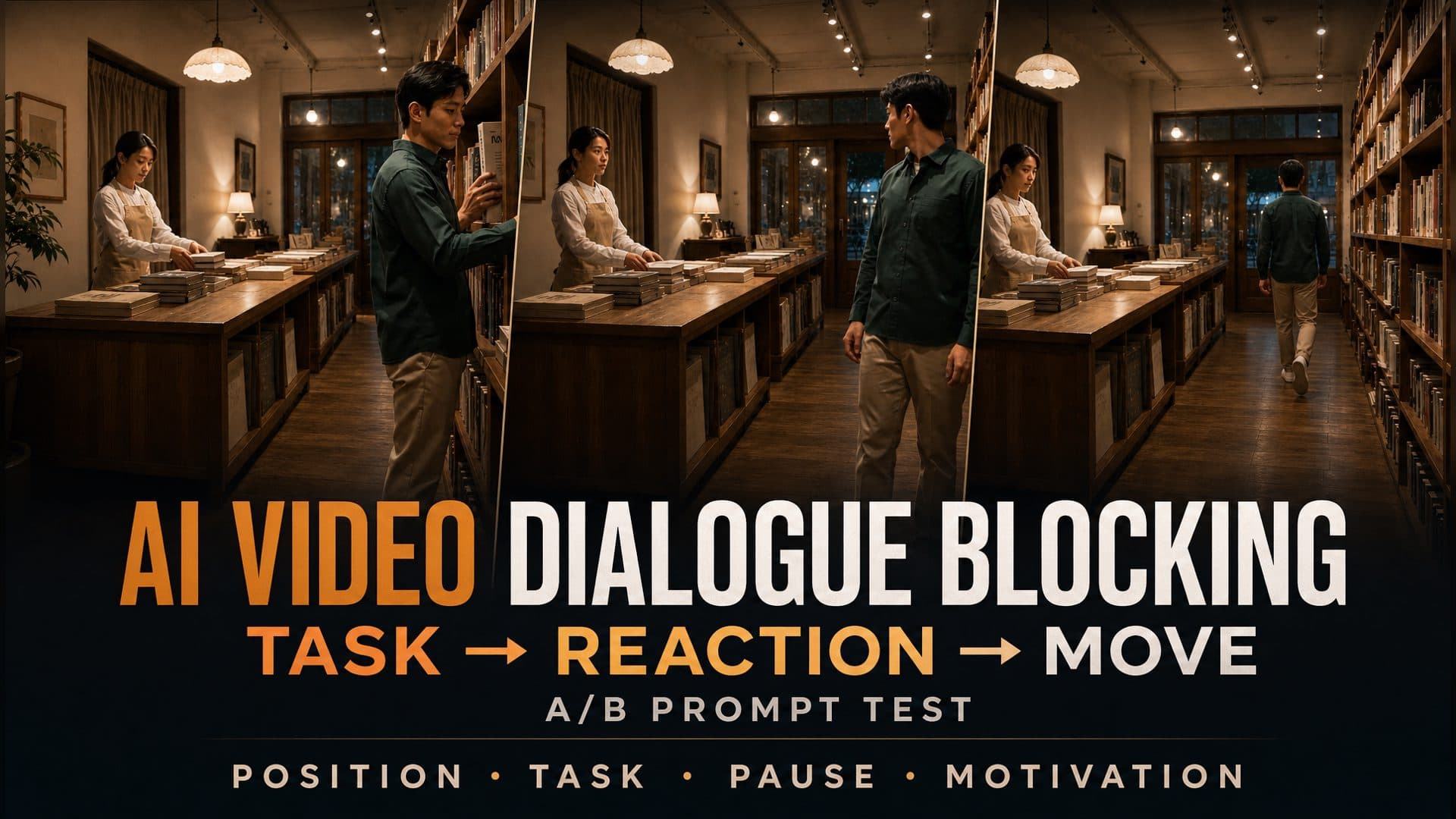
AI video dialogue blocking prompts work best when they specify more than who speaks and who listens. Give each character a practical task, anchor both people to visible parts of the set, stagger their reactions, and let only the person with a reason to move change position. In this AVT-007 test, the same two bookstore employees and the same empty store were used for a general activity prompt and a structured blocking prompt.
A dialogue scene can contain plenty of motion and still feel static. Characters nod, handle props, glance around, or take a few steps, but none of those actions changes the situation. The movement is decoration.
Blocking gives movement a job. It establishes where each person starts, what occupies their attention, what interrupts the routine, who notices first, and how the room looks after someone moves.
For this test, both groups used the same character and location references. The character sheet contains two adult bookstore employees: a woman in a beige apron and a man in a dark green work shirt. The location reference is an empty independent bookstore with a sorting table on the left, tall shelves on the right, a center aisle, and a rear doorway.
Character reference: two employees with distinct wardrobe and silhouettes, isolated from the location.
Location reference: the fixed set anchors used to describe position and movement.
Both clips were generated with Seedance 2.0 Fast at 720p, 16:9, with an eight-second duration setting and audio enabled. The video seed was left open, so this is a single A/B observation rather than a repeatability study.
Group A used a broad direction: two employees organize items, interact, move naturally, and look at one another. Group B turned the same premise into a timed action chain.
Man moves toward the rear, woman stays at the table
That difference matters because a model can execute “natural movement” without producing an event. A timed blocking prompt tells it which action should become meaningful.
Frame comparison: activity versus an action chain
1. Start with a visible job for each character
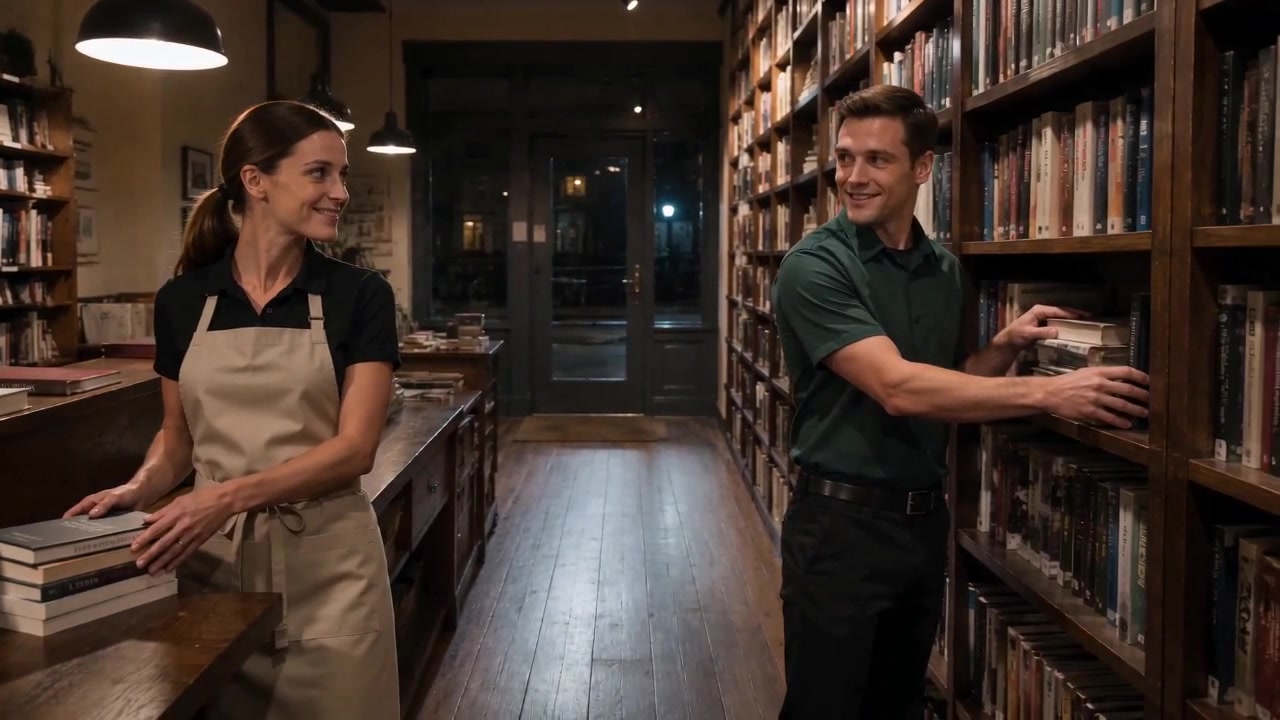
At 2.5 seconds, Group A has placed both employees inside the bookstore. They are active, but the prompt has not made their responsibilities easy to audit.
Group A at 2.5 seconds: the scene has activity, while the division of labor remains broad.
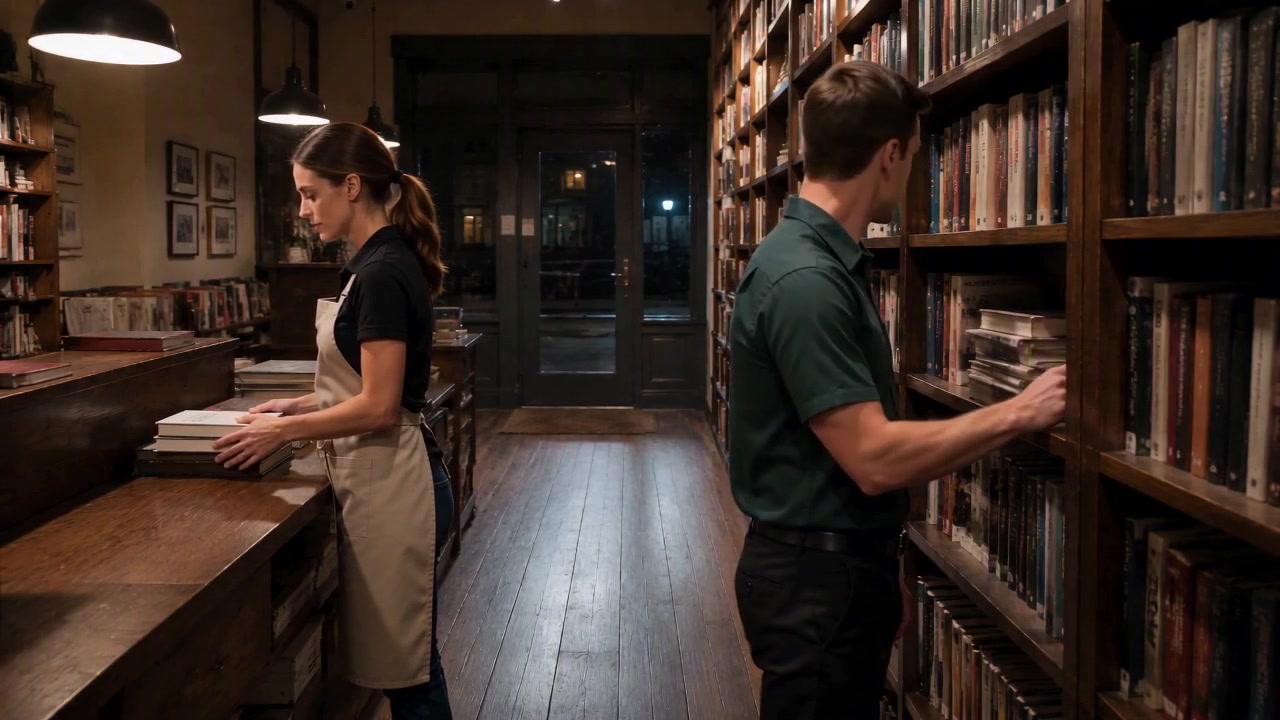
Group B begins from explicit set anchors. The woman belongs to the sorting table on the left. The man belongs to the shelves on the right. Their jobs are different enough that stopping either action can be seen.
Group B opening: separate positions and tasks establish the room before the interruption.
The prompt language is simple:
Character A works at the sorting table on the left, slowly stacking books.
Character B stands at the shelves on the right and slides one book into place.
“Busy” is hard to judge. Stacking a book or returning one to a shelf is concrete.
2. Make attention move from one person to the other
By four seconds, Group A has produced interaction, but no external change gives the exchange a dramatic direction.
Group A at four seconds: the interaction is plausible, but the prompt leaves the cause and order open.
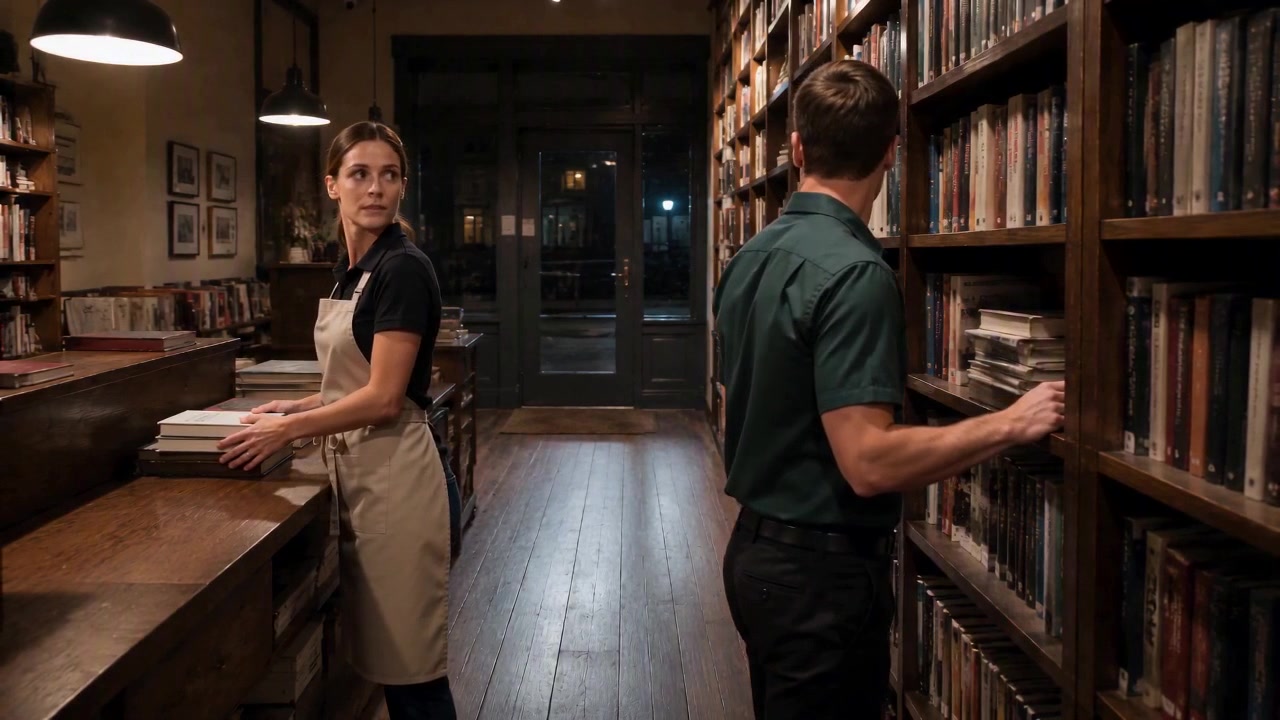
Group B names a trigger and assigns the first response to the man. At 2.5 seconds, the action is still organized around his shelf task and the rear-door direction.
Group B at 2.5 seconds: the scene has a designated first responder instead of synchronized movement.
At four seconds, the woman’s later response creates a handoff of attention. A generated clip will not always hit a written beat at the exact frame, but the prompt now gives the sequence something testable.
Group B at four seconds: reaction order becomes part of the performance rather than an incidental gesture.
Use time words sparingly and clearly:
A sound comes from the rear-door area.
Character B stops first and turns toward it.
After a brief beat, Character A looks up at Character B.
The pause is doing real work. It prevents both characters from receiving the same animation instruction at the same time.
3. Give movement a cause, path, and end state
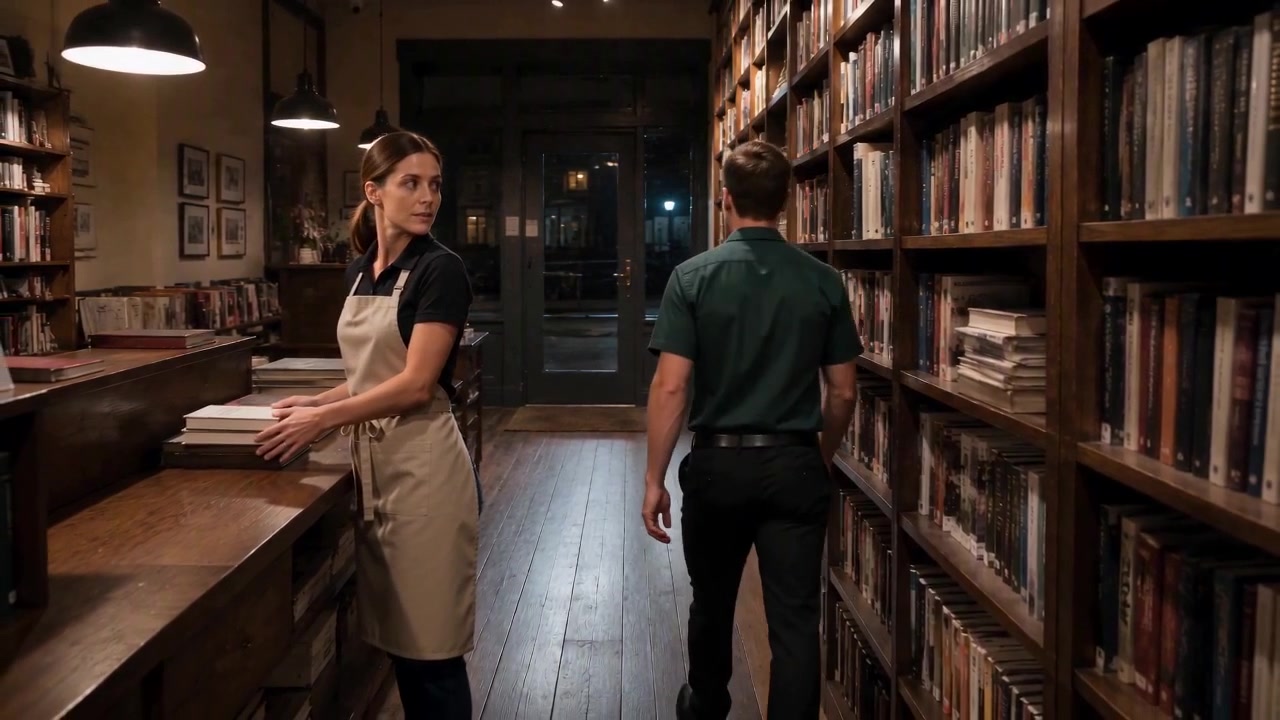
At six seconds, Group B moves into the final phase. The man’s change of position is tied to checking the rear door, not to a generic request to walk naturally.
Group B at six seconds: the move follows the interruption and has a destination.
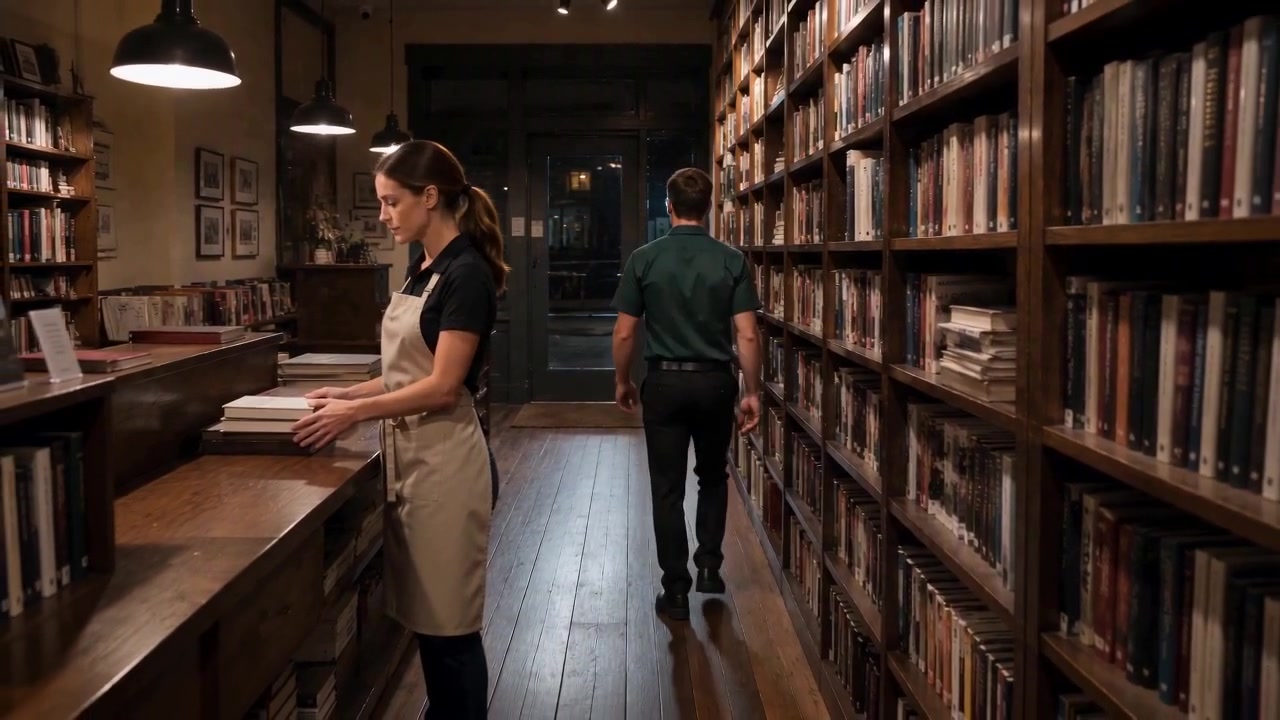
By 7.5 seconds, the blocking has changed the spatial relationship. One employee has moved deeper into the store while the other remains associated with the original work area.
Group B at 7.5 seconds: the final composition records who moved and who stayed.
A useful movement instruction answers five questions in one short block:
Because of the sound, Character B leaves the right shelf,
walks two steps along the right aisle toward the rear door,
while Character A stays at the sorting table.
Widen slightly to keep both positions readable.
The stationary character is not being neglected. She acts as a spatial anchor, making the other character’s move easier to read.
A practical six-step dialogue blocking method
Anchor people to the set
Name objects and architectural features that are visible in the location reference. “Left” and “right” are more reliable when attached to “sorting table,” “bookshelf,” “aisle,” or “rear door.”
Assign different low-complexity tasks
Each task should suit the character’s role and be readable within a second or two. Sorting papers, wiping a counter, closing a laptop, shelving a book, or packing a bag works better than “looks busy.”
Introduce one trigger
A line, sound, prop change, glance, or entrance can interrupt the routine. In an eight-second clip, one clear trigger is usually enough.
Stagger the reactions
Choose who reacts first and why. The first person might be closer to the sound, more suspicious, or responsible for the problem. Let the other person respond after a visible beat.
Move only the character who has a reason
State the starting point, route, short distance, and destination. Also state who remains behind. This reduces random wandering and position swaps.
Re-establish the space
After movement, preserve enough of the set to understand the new relationship. A slight widening, a held wide shot, or a fixed environmental anchor can keep the scene legible.
An eight-second prompt template
Create an eight-second two-character dialogue scene.
Keep the performance restrained and let actions happen in sequence.

0-3 seconds:
Character A stands at [set anchor A] and performs [specific task].
Character B stands at [set anchor B] and performs [different task].
Keep [fixed background anchor] visible.

3-5 seconds:
[One line, sound, prop change, or gesture] interrupts the routine.
Character B stops first and reacts with [gaze, head turn, or body turn].
Hold a short beat.
Character A then responds with [second visible reaction].

5-8 seconds:
Because of [specific reason], Character B leaves [starting point].
Character B follows [visible path] toward [clear target].
Character A stays at [original anchor] and [watches, hesitates, or continues working].
Widen slightly to preserve both characters and the relevant set anchors.

Keep identity, wardrobe, props, and location layout continuous.
Do not swap positions or add unexplained movement.
Treat the timings as priorities, not guarantees. They make the result easier to inspect and revise, even when a model shifts a beat by several frames.
Connect movement to the important line
Dialogue blocking improves when speech and action share the same turning point. A character can continue a simple task through ordinary information, stop when the key line lands, and move only after the line creates a decision.
Character A keeps stacking books during the first sentence.
On “the back door was open,” Character B stops shelving.
Hold on his reaction.
After Character A finishes, Character B walks toward the door.
Avoid adding a gesture to every sentence. Constant motion flattens emphasis. One stopped action can carry more weight than three unrelated hand movements.
Where this method is useful
In a workplace discovery, two coworkers can begin with different tasks until a sound, message, or missing object interrupts them. One investigates while the other holds the original position.
In a restrained argument, one character can pack or clean while the other waits near an exit. A difficult line stops the practical task. A step toward the door then reads as a decision rather than filler.
In an interview or briefing, a speaker can remain near a display while the listener reviews documents at a table. Looking up and approaching the display marks the shift from passive listening to active examination.
The same structure can extend to three people, but reaction order becomes more important. Give one person the first response, another the consequential move, and the third a stable observation role.
How to review a generated dialogue scene
Check the opening, trigger, response, and final position as separate beats. Ask whether each person starts with a distinct task, whether one reaction clearly precedes the other, whether the move has a destination, and whether the person who stayed remains part of the composition.
Then watch the full clip. A set of attractive frames can still hide an unclear transition. The action should feel like cause and effect when played at normal speed.
This AVT-007 result is one comparison with an open seed. It shows how a structured prompt can make blocking decisions visible and reviewable, but it does not establish a universal success rate. Repeat the test with several random states and with spoken dialogue before treating the timing as stable.
Frequently asked questions
What is character blocking in an AI video prompt?
Character blocking describes where performers begin, what they are doing, how attention passes between them, who moves, and how their relationship to the set changes. It turns general activity into a sequence the viewer can follow.
Should both characters move during a dialogue scene?
Usually not. A stationary character can anchor the room and make the other person’s movement meaningful. Move a character when the story gives that person a reason to change position.
How many actions fit into eight seconds?
A practical test can hold two opening tasks, one trigger, two staggered reactions, and one short move. More actions leave less room for readable pauses.
Do timestamps guarantee exact action timing?
No. They establish order and emphasis. Review the generated frames and full clip, then adjust the time windows if an important beat starts too early or too late.
Open the AVT-007 ArtArch workflow to inspect the references, both prompts, complete videos, and extracted comparison frames.