

ArtArch Newsroom
AI Video TechniquesHow to Write Layered AI Video Sound Prompts
Learn how layered AI video sound prompts organize dialogue, synchronized effects, ambience, music, timing, distance, and emotional priority.
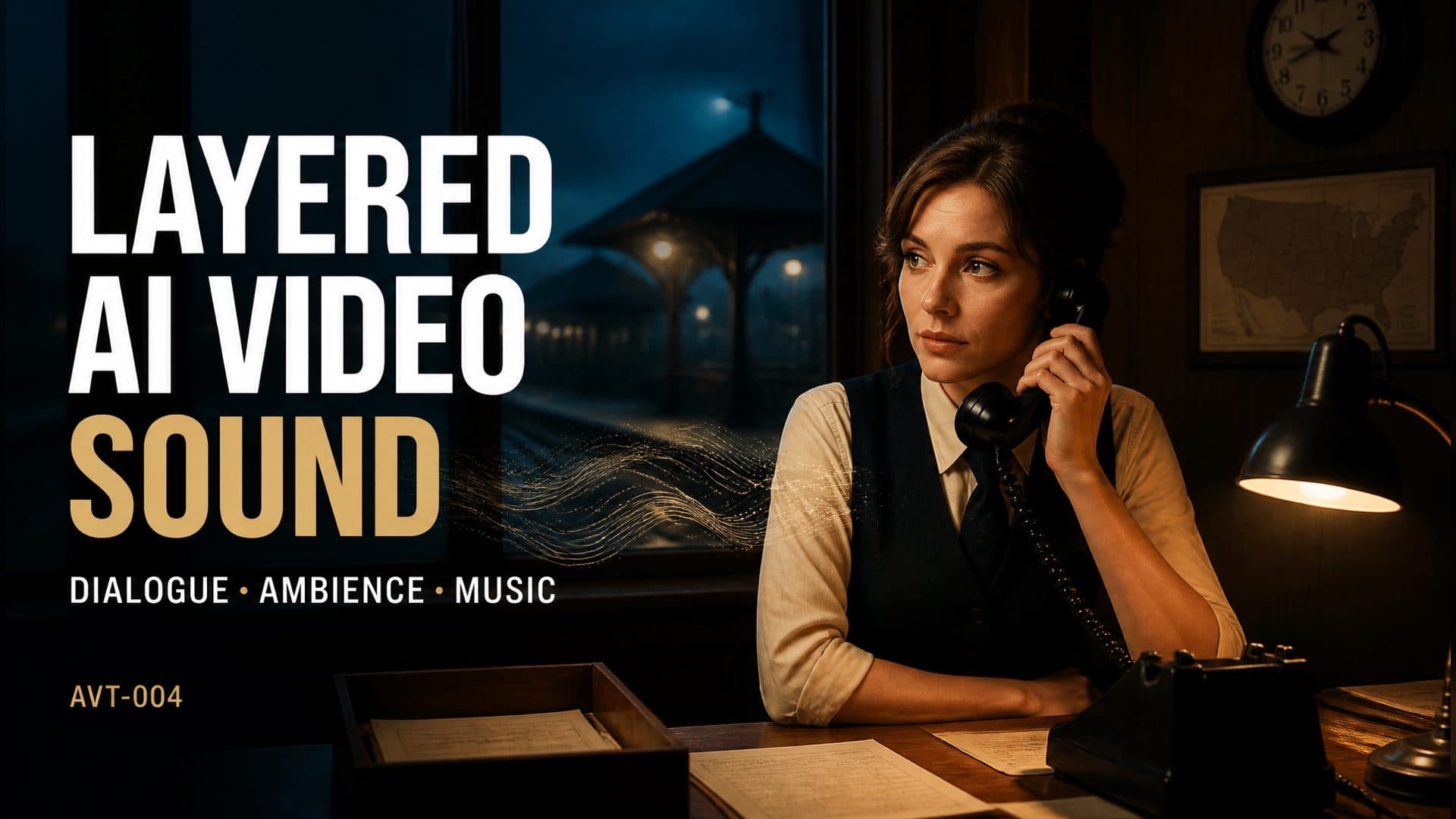
Provide a character reference and an empty location reference to create a dialogue-driven AI video with clear speech, synchronized object sounds, distant ambience, and restrained music. This AVT-004 scene follows a night station attendant in a small railway office as she answers a desk phone, delivers one quiet line, and sets down the receiver.
The visual action is simple so the sound hierarchy can carry the emotion. The audience should hear the line first, feel the empty station through its background sounds, register the receiver landing at the exact moment of contact, and sense low strings entering without overwhelming the performance.
Sound prompts need a clear priority structure
A prompt that asks for dialogue, wind, train sounds, a phone click, and sad music gives the model several valid ingredients. It leaves the relationship between those ingredients open. The voice may become difficult to understand, the music may arrive too loudly, or the object sound may drift away from the visible action.
A layered AI video sound prompt assigns every element a role:
- dialogue carries the story;
- music supports the emotional turn;
- ambience defines distance and location;
- synchronized effects confirm physical actions.
For this scene, the listening priority remains dialogue above music above ambience.
The control prompt
The control version describes the soundtrack broadly:
A night station attendant picks up the desk phone and quietly says, “The last train has already left.” After a pause, she slowly lowers the receiver. Generate synchronized sound with clear dialogue, nighttime ambience, and sad background music.
This identifies the essential content. It gives the generation system freedom to decide loudness, timing, spatial position, vocal delivery, and the way music enters.
The layered technique prompt
The technique version keeps the same performer, station office, framing, duration, and visual action. It defines the sound by time, distance, performance, and priority.
From 0–5 seconds, dialogue stays in the foreground. She speaks in restrained, tired American English with a slight breathiness: “The last train has already left.” The pace is slow, with a short pause after “already,” and the voice carries the brief natural reverb of a small wood-paneled office. From 0–8 seconds, low wind outside and an occasional distant rail-metal sound remain the quietest layer, positioned behind her to the right. At 5–6 seconds, the receiver lands with one soft plastic click synchronized to contact. From 2–8 seconds, very soft low strings enter gradually, below the dialogue but above the room noise, and remain restrained through the ending.
The added detail turns sound design into a sequence the viewer can follow. Speech has a performance direction. The room has acoustic character. The station ambience has distance and screen position. The receiver click has a visible sync point. Music has an entrance and a ceiling.
Keep exploring
More in AI Video Techniques

Motivated Cut AI Video Continuity: Change the Shot for a Reason
Learn how a visible action trigger, clear shot-size change, and locked screen direction create more intentional same-scene AI video edits.
Deep Depth of Field AI Video: Keep Every Story Layer Readable
Learn how deep depth of field AI video prompts keep foreground tools, central action, and distant location cues readable in one layered shot.

Medium Depth of Field AI Video: Balance Subject and Setting
Learn how medium depth of field AI video prompts keep hands and active objects readable while preserving recognizable environmental context.

AI Video Character Reference Framing: Match Portraits to Landscape Shots
Prepare vertical character portraits for landscape AI video by matching aspect ratio, body scale, headroom, floor space, and movement room before generation.