AI Video Dialogue Blocking Prompts: Turn-Taking, Tasks, and Motivated Movement
Use AI video dialogue blocking prompts to assign character tasks, stagger reactions, motivate movement, and preserve readable space in short scenes.
11 min read
Give each character a position, a practical task, and a different response time before asking anyone to walk. These AI video dialogue blocking prompts turn a static two-person setup into a readable chain of actions: one person notices a disturbance, the other reacts a beat later, and only the character with a reason to move leaves the starting position.
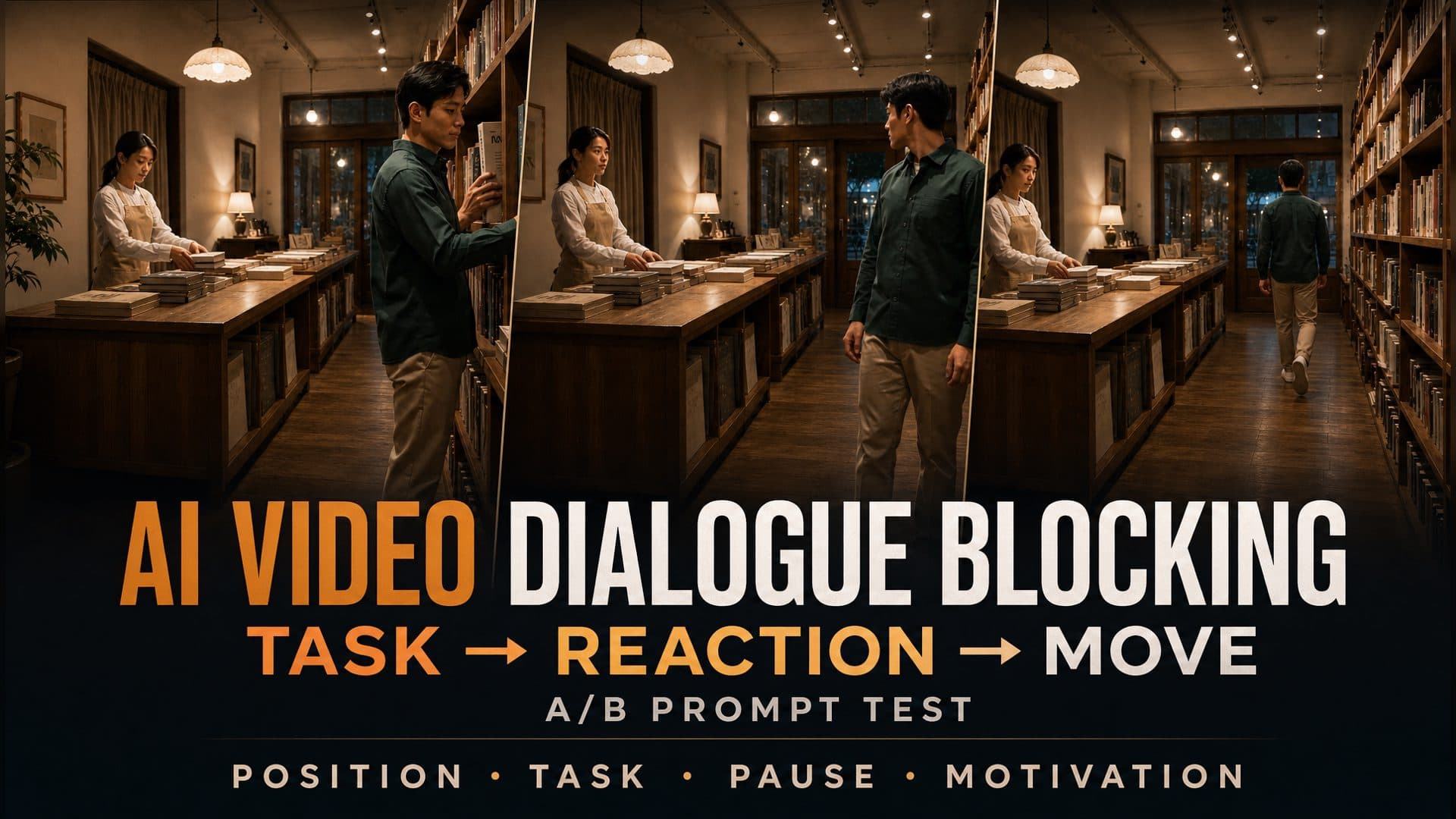
AVT-007 compares a general activity prompt with a structured blocking prompt in the same bookstore. Both samples preserve the two employees and the warm wooden interior. The general version produces credible work gestures and a brief exchange of looks. The structured version creates a clearer event: the male employee stops shelving a book, turns toward a sound near the rear door, waits for the female employee’s reaction, and walks toward the source while she stays at the table.
The useful distinction is not motion versus stillness. It is decorative motion versus motivated action.
What the A/B test showed
Both samples use the same reference image of two bookstore employees and the same empty bookstore reference. The woman wears a pale apron and begins near the long table on the left. The man wears a dark green shirt and begins at the wall of bookshelves on the right.
Each result is 1280 × 720, 16:9, and about 8.06 seconds long. Both files contain an audio track. The review focuses on visible character tasks, reaction order, movement motivation, and the spatial relationship after one person moves.
The control sample is visually coherent. At approximately 2.5 seconds, the woman handles books at the central table while the man works at the right shelf. Near the middle, they look toward one another. By the final seconds, both have returned to their tasks. The result feels calm and plausible, yet the gestures do not alter the situation.
The structured sample begins with a more legible division of labor. The woman arranges stacks on the left, while the man places a book on the right. He turns his head away from the shelf first. The woman then pauses and raises her gaze. In the final portion, he rotates his body and walks toward the rear door while she remains beside the table.
This is an E1 observation from one location and one generation per prompt, with the video seed left open. It supports a practical blocking method for further testing while keeping the performance claim limited to this sample.
Why dialogue scenes feel static even when characters move
The actions have no object
“Talk naturally and move around” asks for activity while leaving its target open. The model can produce nods, glances, and hand gestures, but the result may leave the change and its cause unclear.
A concrete task creates an object:
Character A sorts three stacks of books on the long table.
Character B returns one book to a chest-height shelf.
The action is now connected to the location and the character’s role.
Everyone reacts at the same time
When two characters stop, turn, look, and step together, the scene can resemble synchronized choreography. Dialogue blocking becomes more natural when attention travels from one character to the next.
Character B stops first and turns toward the rear door.
After a short beat, Character A looks up at Character B.
Words such as “first,” “after a short beat,” and “then” create an order that can be reviewed in the result.
Walking lacks a destination
“Character B walks naturally” leaves the starting point, path, distance, and goal open. A motivated move names all four:
Because of the sound near the rear door,
Character B leaves the right bookshelf,
walks two steps along the right aisle,
and approaches the rear door.
The move changes the relationship between the character and the event.
The scene loses the person who stays
Following the moving character too closely can erase the original spatial map. The second character provides a useful anchor:
Character A remains at the left table and watches.
Widen slightly to keep the table, aisle, and rear door readable.
Stillness now has a function. It makes the other person’s movement measurable.
Read blocking as a chain of causes
Strong blocking can be planned with five connected questions:
Where does each character begin?
What is each person doing before the event?
What new stimulus changes the scene?
Who reacts first, and who reacts after a beat?
Who moves, toward what target, and what remains visible afterward?
The AVT-007 structured prompt answers every question.
The initial positions are the left table and right shelf. The tasks are stacking and shelving. The stimulus comes from the rear-door area. The man reacts first, and the woman follows. The man walks toward the door while the woman stays at the table.
This sequence gives the model more than a list of gestures. It gives every action a previous cause and a next consequence.
A six-part prompt method
1. Anchor each character to the set
Use visible location features instead of floating coordinates.
Character A stands behind the long table on the left.
Character B stands in front of the bookshelf on the right.
The rear door remains visible in the center background.
Set anchors help the viewer understand the distance and direction of later movement.
2. Give each character a role-based task
Choose a task that reads quickly and requires a controlled hand action.
Character A aligns three short stacks of books.
Character B slides one book into an open shelf slot.
Different tasks identify the characters and make a stopped action visible.
3. Introduce one stimulus
The stimulus can be a line of dialogue, an off-screen sound, a prop change, or another person’s behavior.
A small noise comes from the rear-door area.
One stimulus is usually enough for a short test. Several simultaneous events can compete for the same eight seconds.
4. Stagger the reactions
Assign the first response to the character who is closest, most alert, most responsible, or most affected.
Character B stops shelving and turns toward the door first.
Hold a brief pause.
Character A stops stacking and looks toward Character B.
The pause gives the first reaction time to register before the second begins.
5. Motivate one move
State the cause, start point, path, distance, and goal.
Character B leaves the bookshelf because of the sound.
He walks two steps through the right aisle toward the rear door.
Character A remains beside the table.
Limiting the move to one person reduces competing motion and gives the action a clear subject.
6. Re-establish the room
Describe what the camera needs to preserve after the move.
Widen slightly as Character B moves.
Keep Character A, the left table, the right aisle,
and the rear door within the same readable layout.
Re-establishing can use a separate wide shot, a subtle widening, or a composition that retains fixed set features.
An eight-second dialogue blocking prompt template
Create an eight-second two-character dialogue scene.
Keep every movement restrained, sequential, and motivated.

0–3 seconds — establish positions and tasks:
Character A stands at [visible set anchor A] and performs [specific role-based task].
Character B stands at [visible set anchor B] and performs [different specific task].
Keep [fixed environmental anchor] visible.
Establish the distance and body orientation between the characters.

3–5 seconds — trigger staggered reactions:
[A line, off-screen sound, prop change, or gesture] becomes the stimulus.
Character [B] stops the current task first and responds with [gaze, head turn, or body turn].
Hold a short pause.
Character [A] then responds with [second visible reaction].
Do not make both characters perform several complex actions at the same time.

5–8 seconds — use motivated movement:
Because of [specific reason], Character [B] leaves [starting point].
Character [B] follows [visible path] for [short distance] toward [clear target].
Character [A] remains at [original anchor] and [watches, hesitates, or continues the task].
Widen slightly to re-establish both characters, the path, and the target.

Keep character identity, wardrobe, props, and the location layout continuous.
Preserve the action order and avoid unexplained position swaps.
This template can expand to longer scenes by giving each dialogue beat its own pause, task change, or motivated move. The causal structure stays the same.
How to connect movement to dialogue
Dialogue and blocking should share the same beat. A character can continue a low-attention task during ordinary information, stop during an important line, and move only when the line creates a decision.
For example:
Character A continues stacking books during the first sentence.
On the phrase “the back door was open,” Character B stops shelving.
Hold on Character B’s reaction.
After Character A finishes speaking, Character B walks toward the door.
This produces a visible hierarchy. The practical task supports the beginning, the pause emphasizes the key information, and the walk expresses a decision.
Avoid assigning a new gesture to every sentence. Constant motion can flatten emphasis because no single action receives enough time to matter.
Three scene types that benefit from blocking prompts
A workplace discovery
Two coworkers perform different tasks until a sound, message, or missing object interrupts them. One investigates while the other remains behind. Their positions show responsibility and hesitation without requiring exposition.
A restrained argument
One character cleans, packs, or handles a prop while the other waits near an exit. A difficult line stops the task. A step toward the door can become a threat to leave, while the stationary character decides whether to follow.
An interview or briefing
A speaker stands near a board while a listener reviews documents at a table. The listener looks up after a key detail, then approaches the board. The move marks a transition from passive listening to active examination.
The method also works in three-character scenes, but the reaction order needs more care. Give one character the first response, a second character the consequential move, and the third character a stable observation role.
How to review the generated blocking
Start with four representative frames:
The opening frame should show two distinct positions and tasks.
The trigger frame should show one character interrupting a task first.
The response frame should show the second character reacting after the first.
The final frame should show a motivated position change while preserving the person who stayed and the relevant set anchors.
Then watch the clip in motion:
Can you identify the cause of the first reaction?
Does attention pass from one person to the other?
Does the moving character have a clear destination?
Does the stationary character remain part of the scene?
Can you still locate the table, aisle, and door after the move?
Do identity, wardrobe, props, and body orientation remain continuous?
Repeat the same prompt across multiple random states before treating one success as a stable rule. A useful next test adds spoken dialogue and checks whether the pause aligns with the important phrase.
Frequently asked questions
What is character blocking in an AI video prompt?
Character blocking is the planned relationship between performers, props, set features, and camera space. A useful prompt names starting positions, practical tasks, reaction order, movement motivation, path, destination, and the spatial state after movement.
Should every character move during a dialogue scene?
No. One character can remain still to anchor the composition and make another character’s move meaningful. Movement is most useful when it expresses a decision, a shift in attention, a change in power, or a response to a specific event.
How many actions fit in an eight-second AI video?
A compact scene can usually support an initial task, one stimulus, two staggered reactions, and one short motivated move. More actions can work, but each added demand reduces the time available for pauses and clear transitions.
Click the template card to enter the experience page and try this AI video dialogue blocking prompt with your own characters, tasks, stimulus, and motivated move.
AI Video Dialogue Blocking Prompts: Turn-Taking, Tasks, and Motivated Movement | ArtArch